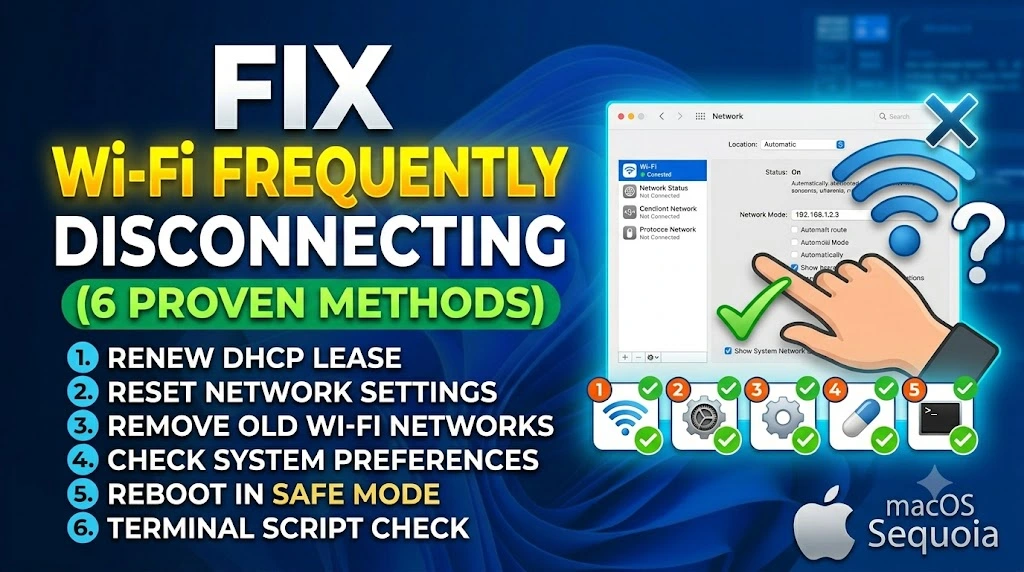
If your Mac keeps dropping Wi-Fi every few minutes on macOS Sequoia, you are dealing with one of the more frustrating upgrade side effects Apple users have reported since the Sequoia rollout. The connection does not fail outright — it just cuts out briefly, reconnects, and repeats. That pattern is exactly what makes it so disruptive, especially during video calls or file transfers.
Three root causes cover the vast majority of cases: macOS Sequoia introduced a new Wi-Fi scanning behavior that aggressively searches for stronger networks and drops your current one mid-session, the network configuration cache (known as the PLIST files) can corrupt during an OS upgrade and cause unstable handshakes, and certain DNS configurations that worked on Ventura or Sonoma simply do not play well with Sequoia’s updated networking stack. None of these require a fresh macOS install or a call to Apple Support. This guide walks you through six tested fixes, starting with the simplest toggle and progressing to a clean network slate if needed. By the end, you will have a stable connection.
Technical Specifications
| Technical Detail | Specification / Requirement |
|---|---|
| Target Platform | macOS Sequoia (15.0 and later) |
| Error Type | Wi-Fi drops / frequent disconnections |
| Affected Component | Wi-Fi adapter, network stack, DNS resolver |
| Difficulty Level | Beginner to Intermediate |
| Estimated Fix Time | 5 – 25 minutes |
| Tools Required | System Settings, Terminal, Keychain Access |
| Risk Level | Low (no data loss; network prefs can be restored) |
| Applies To | MacBook Air, MacBook Pro, Mac mini, iMac |
Method 1: Disable Wi-Fi Auto-Join for Competing Networks
macOS Sequoia can silently switch between saved networks when it detects a stronger signal nearby — even if that “stronger” network is a neighbor’s router you connected to once. This background scanning causes the brief disconnection you keep experiencing.
- Click the Apple menu () and open System Settings.
- Select Wi-Fi from the left sidebar.
- Click the Details button next to your current connected network.
- Ensure Auto-Join is toggled on for your primary network.
- Scroll down and click Edit next to Known Networks.
- Find any unfamiliar or rarely-used networks in the list and click the minus (–) button to remove them, or toggle off Auto-Join for each one individually.
- Click Done and monitor your connection for 10 minutes.
Removing old networks prevents macOS from treating them as viable candidates during background scanning, which eliminates the leading cause of random drops on Sequoia.
Method 2: Flush the DNS Cache via Terminal
Sequoia’s DNS resolver can hold onto stale or conflicting cache entries from a previous macOS version, causing connection timeouts that look exactly like Wi-Fi drops. Flushing it takes under 30 seconds and has zero risk.
- Open Terminal — find it in Applications → Utilities or search with Spotlight (
Command + Space, then type Terminal). - Type the following command exactly and press Return:
sudo dscacheutil -flushcache; sudo killall -HUP mDNSResponder - Enter your Mac’s administrator password when prompted (the cursor will not move while you type — that is normal).
- Wait for the command to complete — it runs silently with no confirmation message.
- Open Safari or Chrome and load a webpage to verify the connection is stable.
This command resets both the DNS lookup cache and the mDNSResponder process, which handles local network name resolution. It is safe to run repeatedly and takes effect immediately without a reboot.
Method 3: Delete Corrupted Wi-Fi Preference Files
When you upgrade to macOS Sequoia, your existing network preference files carry over — but they occasionally contain incompatible settings that cause the new network stack to behave erratically. Deleting these files forces macOS to generate clean, Sequoia-native replacements.
- Open Finder and press
Command + Shift + Gto open the Go to Folder dialog. - Type the following path and press Return:
/Library/Preferences/SystemConfiguration/ - Locate the following files in this folder:
com.apple.airport.preferences.plistcom.apple.network.identification.plistNetworkInterfaces.plistpreferences.plist
- Drag all four files to your Desktop as a temporary backup (do not delete them yet).
- Restart your Mac — macOS will automatically recreate these files with fresh defaults.
- Reconnect to your Wi-Fi network and enter the password when prompted.
If your Wi-Fi is now stable after the restart, the original files were the cause. You can delete the Desktop copies after a day of testing. If the issue returns, put them back and move to the next method.
Method 4: Change Your DNS Servers to Google or Cloudflare
macOS Sequoia defaults to your router’s DNS, which is often provided by your ISP. These ISP DNS servers are frequently slow, overloaded, or temporarily unavailable — and when they fail to respond, your Mac interprets it as a lost connection even though your Wi-Fi signal is perfectly fine. Switching to a reliable public DNS server solves this instantly.
- Open System Settings and click Wi-Fi.
- Click Details next to your connected network.
- Select the DNS tab at the top of the panel.
- Click the + button under the DNS Servers list and add the following addresses one at a time:
8.8.8.8(Google Primary)8.8.4.4(Google Secondary)- Or alternatively:
1.1.1.1and1.0.0.1(Cloudflare)
- Click OK to save.
- Open Terminal and run
sudo dscacheutil -flushcache; sudo killall -HUP mDNSResponderto apply the change immediately.
Both Google and Cloudflare DNS servers have global redundancy built in, so they stay available even when ISP infrastructure has issues. Cloudflare’s 1.1.1.1 is consistently the fastest option in independent benchmarks.
Method 5: Reset the Network Settings Using Terminal
If the PLIST deletion in Method 3 did not fully resolve the issue, a deeper network reset using Terminal gives you a more thorough clean slate. This resets your TCP/IP stack, routing tables, and interface bindings — all of which can accumulate stale state across OS upgrades.
- Open Terminal from Applications → Utilities.
- Run each of the following commands in sequence, pressing Return after each one and entering your password when prompted:
sudo ifconfig en0 downsudo ifconfig en0 upsudo route flush - Next, reset your DHCP lease by running:
sudo ipconfig set en0 DHCP - Wait 10–15 seconds for your Wi-Fi interface to re-initialize and obtain a new IP address from your router.
- Check your menu bar for the Wi-Fi icon — it should reconnect automatically.
The en0 interface is your Mac’s primary Wi-Fi adapter. If you are on a Mac with both Wi-Fi and Ethernet, run the same commands substituting en1 for the secondary interface if needed.
Method 6: Remove and Re-Add Your Wi-Fi Network from Keychain
macOS stores Wi-Fi passwords in Keychain Access, and a corrupted Keychain entry for your network can cause authentication failures that look identical to random Wi-Fi drops. Removing and re-entering the saved credentials gives you a clean authentication handshake.
- Open Spotlight (
Command + Space), type Keychain Access, and press Return. - In the search bar, type the name of your Wi-Fi network (SSID).
- Double-click the network entry that appears in the results.
- Click Delete when prompted to confirm removal.
- Open System Settings → Wi-Fi and click Details next to your network.
- Click Forget This Network, then confirm.
- Reconnect to your Wi-Fi from the Wi-Fi menu and enter your password fresh.
This is especially effective when the disconnection pattern started after a password change on your router, since the old Keychain entry may be causing silent authentication renegotiations in the background.
Frequently Asked Questions
Why did Wi-Fi start disconnecting only after upgrading to macOS Sequoia?
macOS Sequoia made changes to the Wi-Fi roaming algorithm and network stack that are not fully backward-compatible with every router firmware. Specifically, Sequoia is more aggressive about background network scanning for better access points, and it adjusted how DHCP lease renewals are handled. Both behaviors can cause brief drops on routers running older firmware. Updating your router’s firmware from the manufacturer’s admin panel — typically accessible at 192.168.1.1 or 192.168.0.1 in a browser — often resolves compatibility gaps that the Mac-side fixes cannot address on their own.
Can my router’s 2.4 GHz and 5 GHz bands cause this issue on macOS Sequoia?
Yes, absolutely. When both bands share the same network name (SSID), your Mac constantly evaluates which band offers a better signal and switches between them — a process called band steering. Sequoia handles this transition less gracefully than previous macOS versions, causing a brief drop during the switch. The cleanest fix is to log into your router’s admin panel and give the 2.4 GHz and 5 GHz bands separate names (e.g., HomeNetwork and HomeNetwork_5G). Then connect your Mac exclusively to the 5 GHz band for faster, more stable throughput.
My Wi-Fi still disconnects after trying all methods — what should I do next?
If all six methods above have been applied and the problem persists, the issue is likely hardware-adjacent rather than software. Run Apple Diagnostics by restarting your Mac and holding the D key during startup — this tests the Wi-Fi card and reports any hardware faults. Also try connecting to a mobile hotspot to determine whether the problem follows your Mac or stays on your home network. If the hotspot connection is stable, your router itself may need a factory reset or firmware update. If the disconnections happen on every network, contact Apple Support and mention that you have already completed a DNS flush, PLIST reset, and network stack reset — this helps them skip the basic checklist and escalate faster.
Published on Taazamind.com | Category: OS & Software Fixes Tested on macOS Sequoia 15.0 and 15.1 on MacBook Pro M2 and MacBook Air M3