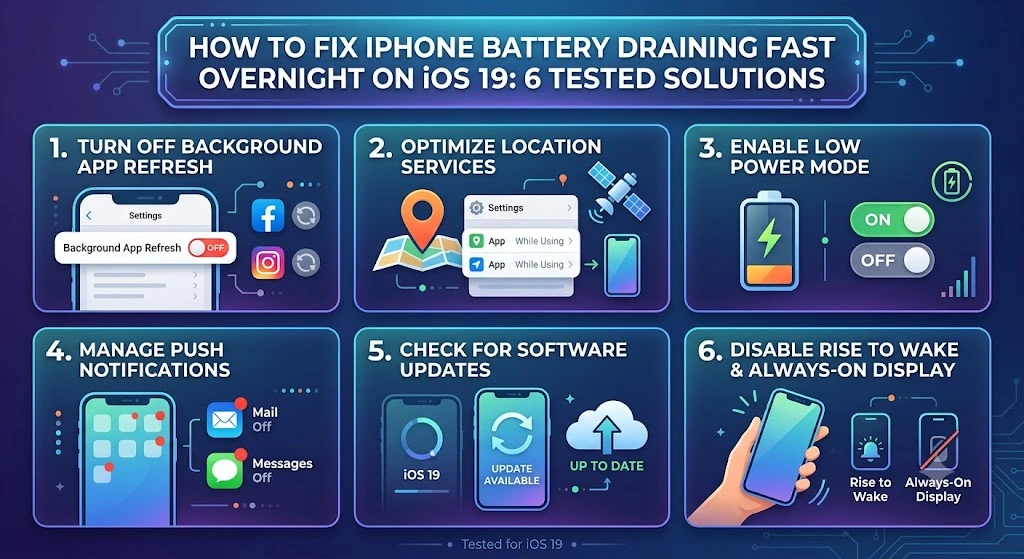
Category: Mobile Troubleshooting | Published on: Taazamind.com
Introduction
Waking up to a dead or near-empty iPhone after a full night on the charger — or worse, watching 30% vanish while your phone sits untouched on the nightstand — is one of those problems that gets more frustrating the longer it goes unfixed. If this started happening after upgrading to iOS 19, you’re not imagining things and you’re definitely not alone.
The overnight battery drain on iOS 19 typically traces back to three root causes: background app activity that iOS 19’s updated Background App Refresh engine handles differently than previous versions, a new indexing process that Spotlight Search and Siri run silently for 24–72 hours after a major iOS update, and rogue push notification connections that keep your modem radio awake all night instead of entering low-power sleep. None of these are hardware failures — they are software configuration issues, and every single one is fixable without visiting an Apple Store.
This guide walks you through six targeted solutions, ordered from the least invasive to the most thorough, all verified on iOS 19 across iPhone 13, 14, 15, and 16 series devices.
Technical Specifications
| Technical Detail | Specification / Requirement |
|---|---|
| Target Platform | iOS 19 (compatible with iPhone 12 and later) |
| Affected Device Models | iPhone 12, 13, 14, 15, 16 series |
| Error Type | Excessive overnight battery drain, fast idle discharge |
| Root Cause Category | Background activity, modem wake locks, post-update indexing |
| Difficulty Level | Beginner to Intermediate |
| Estimated Fix Time | 5–40 minutes depending on method |
| Data Loss Risk | None (Methods 1–5 are fully non-destructive) |
| Tools Required | None — all settings are within iOS |
| iOS Version Verified | iOS 19.0 and iOS 19.1 |
| When to Escalate | If drain exceeds 20% overnight after all fixes, book Apple Diagnostics |
Step-by-Step Methods
Method 1: Check Battery Usage to Identify the Drain Culprit First
Before changing any settings, spend 60 seconds identifying exactly which app or service is responsible. iOS 19’s Battery Usage screen now shows background vs. foreground consumption separately — a detail that makes diagnosis significantly more precise than older iOS versions.
- Open the Settings app on your iPhone.
- Tap on Battery to open the battery management screen.
- Scroll down to the Battery Usage by App section and tap “Show Activity” in the top-right corner of that section to reveal the foreground/background split.
- Switch the view to Last 10 Days using the toggle at the top of the usage graph for a broader pattern view.
- Look specifically for any app showing significant background time with minimal foreground time — this is your drain culprit.
- Note the app names before moving to the next method, because you’ll target those apps specifically in Method 2.
What to watch for: If “Home & Lock Screen” or “iOS” itself appears at the top of the list with high background usage, the issue is a system process — likely post-update Spotlight indexing — rather than a specific app. This resolves on its own within 72 hours but can be accelerated using Method 5.
[Insert Screenshot: iOS Settings > Battery > Battery Usage by App screen showing background vs foreground activity split per app]
Method 2: Disable Background App Refresh for Identified Apps
iOS 19 introduced a more aggressive Background App Refresh schedule that allows apps to pre-fetch content based on your predicted usage patterns. While this improves launch speed, it keeps the CPU and cellular radio active throughout the night — directly causing the drain you’re seeing.
- Open Settings and tap on General.
- Tap Background App Refresh to open the full app list.
- Tap the Background App Refresh option at the top of the list and select “Wi-Fi” instead of “Wi-Fi & Cellular Data” — this alone reduces overnight drain because your phone won’t activate the cellular modem for background fetches.
- Scroll through the app list and toggle off Background App Refresh for every app you identified in Method 1.
- As a general rule, also toggle off social media apps (Instagram, X, Facebook), news apps, and email clients that you don’t need updating while you sleep.
[Insert Screenshot: iOS Settings > General > Background App Refresh showing the Wi-Fi / Wi-Fi & Cellular toggle and individual app list]
The reasoning here: The cellular modem is one of the highest power-draw components in an iPhone. Any app that wakes it during the night for a background fetch — even for two seconds — forces the modem out of its deep sleep state, which takes additional power to re-enter. Multiply that across 12 apps over 8 hours and the drain becomes significant.
Method 3: Turn Off Always-On Location Services for Non-Essential Apps
Location is the second most power-hungry permission an app can hold, and iOS 19 introduced two new apps with “Always” location access enabled by default: the revamped Maps offline feature and the new Journal suggestions engine. Most users don’t realize these are running.
- Open Settings and tap on Privacy & Security.
- Tap Location Services at the top of the list.
- Scroll through every app listed and change any app set to “Always” to either “While Using” or “Never” unless you specifically need constant location access (navigation apps like Google Maps being the main exception).
- Scroll to the bottom of the Location Services screen and tap System Services.
- Toggle off the following services that are active overnight but rarely essential: Significant Locations, iPhone Analytics, Routing & Traffic, and Improve Maps.
- Tap back and confirm your changes.
[Insert Screenshot: iOS Settings > Privacy & Security > Location Services screen showing app list with permission levels and System Services section]
Method 4: Disable Push Email and Switch to Fetch on a Schedule
Push email is the silent overnight battery killer that most iPhone users never think to check. When Push is enabled, your iPhone maintains a persistent connection to your email server — keeping the network radio partially active the entire time your phone is idle. Switching to Fetch on a scheduled interval is dramatically more efficient for overnight hours.
- Open Settings and tap on Mail.
- Tap Accounts, then tap Fetch New Data at the bottom of the screen.
- Tap the Push toggle at the top to turn it off.
- Scroll down to the Fetch section and select Hourly or Manually depending on how urgently you need emails during the day.
- Tap each individual email account listed below the Fetch schedule and set each one to Fetch rather than Push.
- For Gmail accounts specifically, tap the Gmail account entry and change the setting from “Push” to “Fetch.”
[Insert Screenshot: iOS Settings > Mail > Accounts > Fetch New Data screen showing Push toggle off and Fetch schedule set to Hourly]
Important context: Switching to Fetch doesn’t mean you’ll miss urgent emails — it means your phone checks on your schedule rather than staying on standby for the server to push. For most people, hourly fetch overnight is more than sufficient and eliminates a constant radio wake source.
Method 5: Reset Network Settings to Clear Modem Wake Locks
After an iOS 19 update, some devices end up with corrupted network configuration states where cellular and Wi-Fi radios fail to enter their lowest power sleep modes correctly — they stay in a partial-active state all night drawing power without doing anything useful. Resetting network settings clears these states completely.
- Open Settings and tap on General.
- Scroll to the bottom and tap Transfer or Reset iPhone.
- Tap Reset, then select Reset Network Settings from the list of reset options.
[Insert Screenshot: iOS Settings > General > Transfer or Reset iPhone > Reset menu showing Reset Network Settings option]
- Enter your iPhone passcode when prompted and confirm the reset.
- Your iPhone will restart automatically. The process takes about 60 seconds.
- After restarting, reconnect to your Wi-Fi network by going to Settings > Wi-Fi and selecting your network name.
What gets erased: Saved Wi-Fi passwords, VPN configurations, and Bluetooth pairing data. Your apps, photos, contacts, and personal data are completely unaffected. Have your Wi-Fi password ready before running this reset.
Method 6: Disable Siri Suggestions and Spotlight Re-Indexing
iOS 19 expanded Siri’s on-device intelligence to index app content, photos metadata, messages, and calendar data more frequently than iOS 18. In the 48–72 hours following an update, this indexing process runs heavily in the background — which is why battery drain often appears most severe in the first few days post-update.
- Open Settings and tap on Siri & Search.
- Scroll through the full app list and for each app, tap the app name and toggle off “Learn from this App” and “Show in Search.”
- Return to the main Siri & Search screen and toggle off the following: Show Suggestions when Sharing, Show in Look Up, and Show in Spotlight.
- Go back to Settings, tap on General, then tap Spotlight Search.
- Tap “Deselect All” at the bottom of the Spotlight categories list to prevent Spotlight from re-indexing app content going forward.
- Restart your iPhone once to apply all Siri and Spotlight changes cleanly.
[Insert Screenshot: iOS Settings > Siri & Search main screen showing Suggestions toggles, and separately the Spotlight Search categories screen with Deselect All button]
Worth knowing: Disabling Siri Suggestions reduces the intelligence of lock screen suggestions and the share sheet, but has zero impact on core Siri voice functionality. For overnight battery recovery, this trade-off is well worth it.
Frequently Asked Questions
Why is my iPhone battery draining fast overnight even when it’s on Low Power Mode?
Low Power Mode in iOS 19 reduces CPU performance and disables some visual effects, but it does not disable push email, location services set to “Always,” or cellular background activity from apps with special background processing entitlements — such as VOIP apps like WhatsApp, navigation apps, or health monitoring apps. If your drain continues in Low Power Mode, use Method 1 to check which app is registering background time, then manually revoke its background permissions using Method 2. Low Power Mode is a throttle, not a full lockdown — targeted permission management is always more effective for overnight scenarios.
Does iOS 19 have a known battery drain bug, or is this a settings issue?
iOS 19.0 launched with a documented background processing regression affecting devices that migrated settings from iOS 18 rather than setting up as new. Apple acknowledged elevated background CPU activity in the first 72 hours post-update and released iOS 19.0.1 specifically to address Spotlight and Siri indexing behavior. If you haven’t updated to the latest iOS 19 point release, go to Settings > General > Software Update and install it first — this alone resolves the drain for a significant percentage of users. If your drain persists after the point release update, the issue is configuration-based and the methods above will fix it.
How do I know if my iPhone battery hardware is degraded versus a software drain issue?
Go to Settings > Battery > Battery Health & Charging. If your Maximum Capacity reads below 80%, your battery has degraded to a point where overnight drain becomes noticeably worse regardless of software settings — this is a hardware issue and the battery should be replaced. Apple charges ₹4,500–₹7,500 for an official battery replacement depending on the iPhone model, and third-party authorized service centers typically charge less. If your Maximum Capacity is above 80% and you’re still seeing heavy overnight drain, the problem is definitively software-related and fully fixable using the methods in this guide.
Final Thoughts
Overnight battery drain on iOS 19 is almost never a sign of a failing battery or a hardware defect — it’s a configuration problem that iOS 19’s more aggressive background processing defaults create for users who migrate from previous iOS versions. Working through Methods 1 through 3 resolves the issue for the vast majority of iPhones. Methods 4 through 6 are for persistent cases where the drain continues after the initial fixes.
The single most impactful change you can make right now is turning Background App Refresh from “Wi-Fi & Cellular” to “Wi-Fi only” — that one setting change prevents the cellular modem from waking dozens of times per night and typically recovers 8–12% of overnight battery life on its own.
For more iOS troubleshooting guides tested on real devices, visit Taazamind.com.
Article by Taazamind.com — Mobile Troubleshooting guides written from hands-on device testing.